

Digital transformation is no longer optional in our age of frequent disruption, but it will fail without the right approach to content.
Content fuels every digital experience, transaction, and interaction. And with every touchpoint—whether it’s a product page, app notification, or chatbot exchange—users leave behind valuable signals. Yet most enterprises ignore this data in their content decisions and, essentially, make content decisions in the dark. Half of organizations in our most recent content operations study report they’re not measuring or evaluating content effectiveness or impact.
That’s where content intelligence can change the game.
What Is a Definition of Content Intelligence?
The Content Science team and I define it this way:
Content intelligence represents the systems and software that transform content data and business data into actionable insights for content strategy and tactics with impact.
We arrived at this definition because these three ideas make it useful:
- A systematic approach – Content intelligence is not a one-and-done proposition. It needs a framework, processes, and people.
- Integrating software – It’s impossible to develop content intelligence without the right tools integrated into the framework and processes.
- Content impact – The lens through which to look at the data is content. And success is not getting the content created and launched. It’s making an impact.
In other words, content intelligence helps leaders move from guesswork to evidence-based action.
What Content Intelligence Is Not
We often find it helpful to define something in terms of what it is not. So, when we talk about content intelligence, we do not mean…
Artificial intelligence (AI)
AI uses computer systems to do tasks that typically only humans have been able to do. A quintessential example is IBM Watson’s ability to learn games to the point of beating human chess and Jeopardy champions.
Business intelligence (BI)
BI is using systems and software to process business data (typically operational or financial) and turn it into useful insights to inform business strategy and tactics.
The above areas complement each other and content intelligence. Example areas of overlap include…
- Data that informs business intelligence might also inform content intelligence.
- Content intelligence can help AI write / create content, hyperpersonalize content for more impact, and more.
So, what does a content intelligence system look like? Let’s consider the key elements.
What Are the Core Elements of Content Intelligence?
In The Content Advantage, I explain in detail three pillars of content intelligence. Let’s cover the highlights.
1. Collect Data from Multiple Sources
-
- Assemble and maintain an accurate inventory of all content assets across repositories and activation channels.
- Ensure useful and accurate metadata, tagging, and descriptions.
- Assemble data from multiple systems, ranging from analytics platforms to DAMs to email and social channels.
2. Analyze and Interpret
-
- Define strategic questions tied to KPIs.
- Mine and triangulate data to find meaningful answers to those questions.
- Refine analysis continuously as markets and behaviors shift.
3. Form Insights and Take Action
-
- Assess content effectiveness and ROI / value.
- Deepen understanding of customer or user needs from content.
- Leverage reporting to optimize tactics.
- Update or expand strategy based on performance.
- Predict emerging opportunities and risks before they materialize.
Check out a summary of the elements in this diagram.
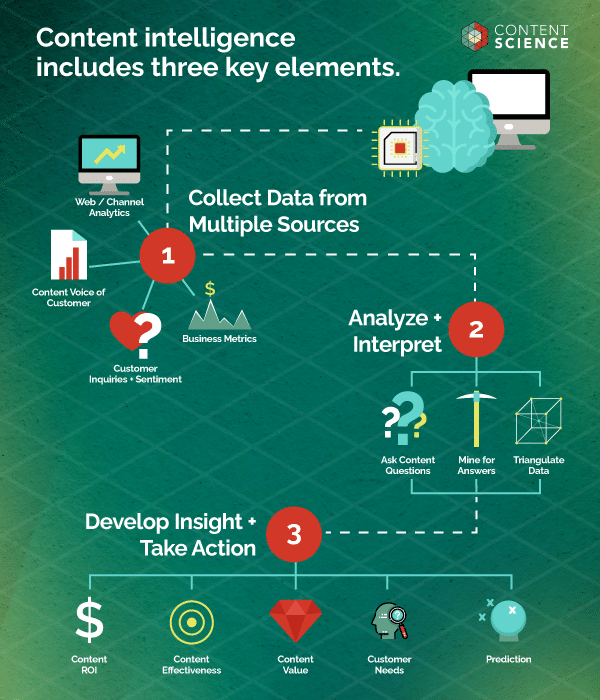
This collect → analyze → act cycle is the engine of content intelligence. Without it, enterprises fly blind. With it, they gain foresight and control.
Now you might be wondering, why should your organization care about this at all, especially now? Let’s take a closer look.
Why Invest in Content Intelligence Now?
In today’s volatile business climate, waiting to build content intelligence isn’t just a missed opportunity—it’s a big risk. Here are six key drivers making it essential now.
1. Shrinking Margins: Cost of Poor Content Decisions
- Avoid wasted effort and investment: Every piece of content that doesn’t serve strategic aims—outdated, duplicative, off-target—represents cost (people hours, tooling, opportunity). Content intelligence helps you identify and retire underperforming assets rather than constantly adding new ones.
- Efficiency gains: With automation, metadata, content inventories, and data triangulation you can cut down on ad hoc work, reduce content production cycle times, and free up resources for higher-impact work.
2. Increasing Complexity of the Landscape
- Channel sprawl: Digital channels, formats, audiences grow more fragmented every day. It’s not unusual for an enterprise to manage dozens, if not hundreds, of owned and paid digital channels. Without content intelligence, content teams can’t make strategic and tactical decisions with speed or certainty, such as whether to reuse content across channels or tailor the content extensively for each channel.
- Content discovery / findability: With search shifting toward AI-driven summaries and generative engines, only content that is structured, measurable, and authoritative will surface. Brands that don’t track narrative authority, semantic signals, and audience perception risk being left out of AI-driven visibility.
3. The Stakes for Reputation, Compliance, & Trust
- Relevance gap: Customer expectations are higher than ever for content that is relevant, timely, and appropriately personalized. Content intelligence helps you understand what content customers actually need, when they need it, and how they prefer it delivered.
- Trust risk: In regulated or reputation-sensitive industries, misleading, stale, or irrelevant content as well as misinformation or fraud by outside actors can damage trust. Content intelligence gives you early warning to correct course.
4. Measurable Growth: Strategic Advantage
- Understanding impact: With proper KPIs, metrics, and data sources (from analytics, content inventories, customer feedback, etc.), content intelligence lets you trace content contribution to business goals such as leads, churn reduction, upsell, retention, call resolution. This insight can enable understanding your return on investing in content.
- Crystallizing value: Content is an intangible asset that investors increasingly value for its impact on brand, reputation, customer satisfaction, and more. Content intelligence helps you quantify that impact.
5. Increasing Demand for ROI from AI
- Benchmarking: Content intelligence helps with comparing the state of your content before using AI and after, which can shed light on whether AI is improving productivity, scale, effectiveness, and more.
- Training AI: Insights from content intelligence can, in turn, help set standards and guidance to optimize your AI solution(s).
6. Competitive Pressures & Market Timing
- First mover advantage: Organizations that establish content intelligence before their competitors can make better content decisions across the content lifecycle and across the customer experience, on which 84% of enterprises say they compete. These decisions can open a gap that their competitors can’t bridge.
- Agility: Market changes happen fast today. Audience behavior shifts, search algorithms evolve, competitors pivot. Content intelligence can help give visibility into trends and risks before they become crises.
What Is the Business Value of Content Intelligence?
Enterprises that embrace content intelligence can reap rewards in many ways. The following four are some of the most common.
- Visibility – Content intelligence helps everyone involved in your content know where it is internally, which improves productivity, accelerates go-to-market, and prevents redundant creation.
- Clarity – Content intelligence clarifies for everyone involved what your content is (its characteristics, compliance, and quality), which can accelerate ideation for new content, reduce legal risk, prevent brand inconsistency, and reduce risk of unnecessary duplication or overlap.
- Utilization – Content intelligence sheds light on how content is used within your channels, which improves governance, reduces risk of wasting existing assets, and helps prevent unnecessary content creation. If you find 50% to 70% of the content your organization creates isn’t utilized, you’re not alone. .
- Effectiveness – Content intelligence reveals whether content works for your customers and your business goals, which enables optimizing content for even better results, predictive insight for content strategy, calculating return on investment, course correcting underperforming content assets or campaigns, training or optimizing AI solutions, and achieving competitive advantage.
In an enterprise, each of these benefits can be worth millions annually. Together, they transform content into a lever of growth.
The Cost of Standing Still
Executives who ignore content intelligence risk serious consequences such as
- Content bloat: Thousands of outdated or redundant assets that overwhelm customers and teams.
- Siloed operations: Fragmented data and workflows that erode efficiency.
- AI misfires: Models trained on poor-quality or ungoverned content that mislead customers or damage trust.
- Lost opportunity: Failure to activate existing assets, wasting sunk investments and delaying innovation.
Related: 6 Areas of AI Risk for Enterprises
The Bottom Line
The age of guessing about content is over. The enterprises that will thrive in the coming decade are those who invest in content intelligence. It’s not about more reports, more dashboards, more numbers, or more tools. It’s about establishing an end-to-end capability that aligns teams; enlightens executives, leaders, and managers; and enables new levels of content impact.
The Authors

Colleen Jones is the president of Content Science and a recognized expert on content, AI, and digital transformation, advising top organizations around the world such as Dell, Thompson Reuters, and The Home Depot. The author of the top-rated book The Content Advantage (third edition), Colleen hosts conversations with senior leaders on the Content Powers AI podcast.
A passionate entrepreneur, Colleen has led Content Science to conduct the world’s largest ongoing study of content operations and AI, develop the patented ContentWRX evaluation system, and architect the AI superagent ContentIQ.
She served as head of content at Mailchimp during its transformation into a marketing platform and eventual $12 billion acquisition by Intuit. Colleen also led customer experience transformation at AT&T and the CDC. Sharing insights based on her experience and her firm’s research, she is a frequent contributor to business and technology publications and podcasts as well as a top LinkedIn Learning instructor. Follow Colleen on LinkedIn.

Content Science transforms content into business advantage in the age of AI. The award-winning firm partners with the world’s top companies and nonprofits to turn content into a strategic asset that powers digital experiences, customer engagement, and AI innovation. Guided by a mission to help worthy organizations make content make a difference, Content Science combines independent research; expert consulting, creative and technical services; and proprietary technologies—including the patented ContentWRX assessment platform and the ContentIQ AI content superagent—to define bold strategies, build better systems, and achieve breakthrough value.



Comments
Comments are closed.
We invite you to share your perspective in a constructive way. To comment, please sign in or register. Our moderating team will review all comments and may edit them for clarity. Our team also may delete comments that are off-topic or disrespectful. All postings become the property of
Content Science Review.