

Do you know if your content strategy is achieving your goals? Most organizations don’t because they don’t have a well-defined measurement plan. According to our recent Content Operations Study, 65% of organizations aren’t regularly evaluating content impact and success.
When asked why they don’t regularly use an analytics measurement plan to measure success, respondents gave several reasons:
- Lack of time – 73%
- Vague objectives and goals – 69%
- Lack of training – 59%
- Lack of tools – 52%
The good news is that many of these challenges can be addressed using the steps below–and it doesn’t have to take a lot of time.
“Rowing harder doesn’t help if the boat is headed in the wrong direction” – Kenichi Ohmae
Why Create a Content Measurement Plan
A content measurement plan provides a framework for measuring success that you can use across your organization to inform decisions around strategy and execution. By having this in place, you can:
- Validate your content strategy and support meaningful conversations around it
- Configure your owned channels for effective analytics
- Identify gaps in analytics you may need to fill
Developing a Content Measurement Plan
You don’t need anything fancy to begin, a simple Excel document will work just fine.
Step 1: Determine Your Audiences
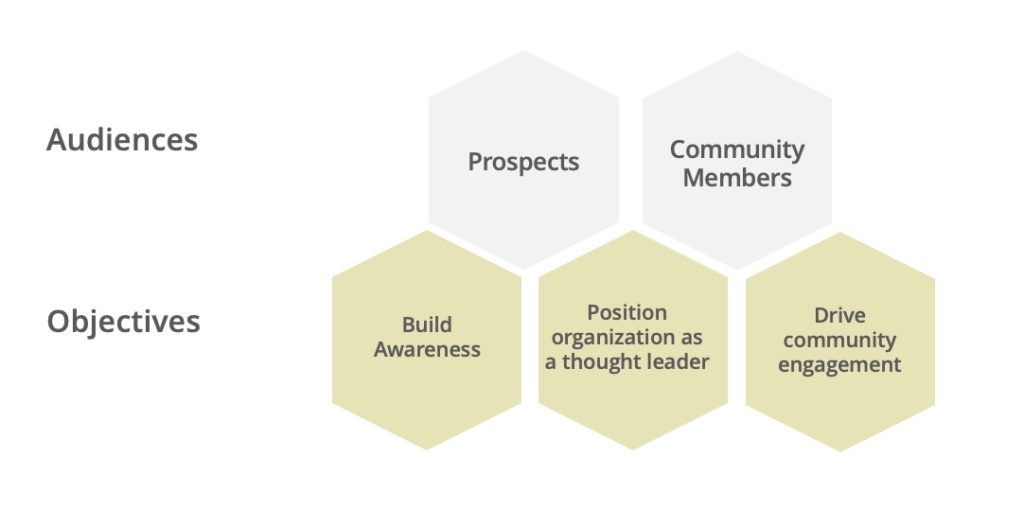
At the top of your measurement plan, list the various audiences you’re trying to influence with your content. If you’ve created user journeys, these user groups would be a good place to start as you likely have a good idea of key goals for each audience.
Your audiences will be important as you determine which segments you need to consider as part of your tracking efforts.
Step 2: Define Your Objectives
Your organization most likely has identified specific business goals. How your department supports those goals will be your objectives. Your objectives should answer the question, “why are we creating content?” Some typical objectives are:
- Build awareness
- Drive community engagement
- Position the organization as a thought leader
Step 3: Establish Your KPIs
After you have objectives, the next step is to identify the critical indicators of success or KPIs. In other words, what measurable value shows that you’re achieving the objectives you’ve outlined. A few rules of thumb for setting KPIs:
- Focus on what matters most for success and answer the question, “will this tell me if our strategy is working?”
- Be sure they are realistic and not based on goals you can’t achieve
- Focus on desired outcomes and not outputs
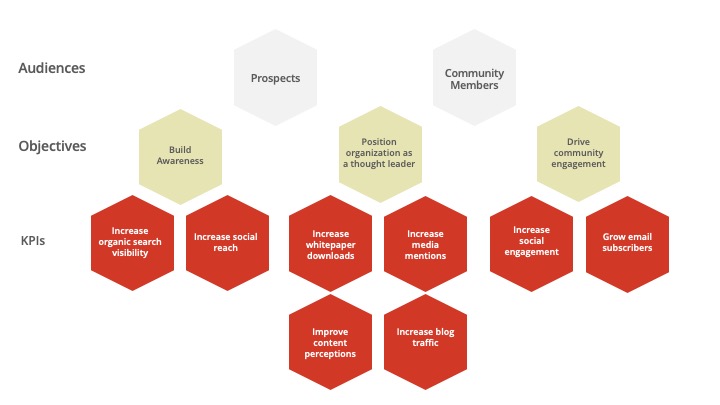
Using the objectives above and armed with quantifiable goals, your KPIs might look something like this:
Build awareness:
- Increased organic search visibility
- Increased social reach
Drive community engagement:
- Increased social engagement
- Growth of email subscribers
Position the organization as a thought leader:
- Increased media mentions
- Increased whitepaper downloads
- Increased blog traffic
- Improved content perceptions
Step 4: Identify Your Metrics
Once you have your KPIs, the next step is to identify the specific quantitative measurements you will track. Often, we find that companies overlook this step because the objectives and KPIs seem to sum it all up. However, this is where the rubber meets the road in having a plan to track the performance of your efforts.
Continuing with our measurement plan examples, some possible metrics could include:
Build awareness:
- Increased organic search visibility: Organic sessions, Branded keyword searches
- Increased social reach: Social reach, Social mentions
Drive community engagement:
- Increased social engagement: New likes, New follows, Average engagement rate, Social shares, Tweets and retweets, Pins and Repins
- Growth of email subscribers: Newsletter subscriptions
Expand thought leadership:
- Increased media mentions: Estimated reach from media pick-ups, News mentions
- Increased whitepaper downloads: Whitepaper downloads
- Increased blog traffic: Blog pageviews, Average pages per session, % new visitors vs % returning, Email clicks on blog articles
- Improved content perceptions: ContentWRX score, Content Sentiment

How to Implement Your Measurement Plan
Now that you have your list of metrics, it’s time to go through and confirm which are already set up for tracking and which you will need to set up. This usually involves checking sources such as:
- Website analytics platform (e.g., Google Analytics, Adobe Analytics)
- Social listening tools (e.g., Talkwalker, Sprinklr)
- Email marketing platform (e.g., MailChimp, GetResponse)
- Content effectiveness tools (e.g. ContentWRX)
This could also include reports from your sales team or offline activity such as event attendance.
Whether you or someone else handles the implementation, it’s important to spell out exactly how each metric will be reported as well as any specific audience segments to isolate.
If you find that there’s something you want to track that’s not currently set up, you might need to research a new analytics tool or approach. In this case, the measurement plan will help you communicate to stakeholders and potential vendor partners what you’re trying to achieve. You can find a worksheet to identify gaps and redundancies in your current content evaluation tools and methods in our Evaluating Content Effectiveness whitepaper.
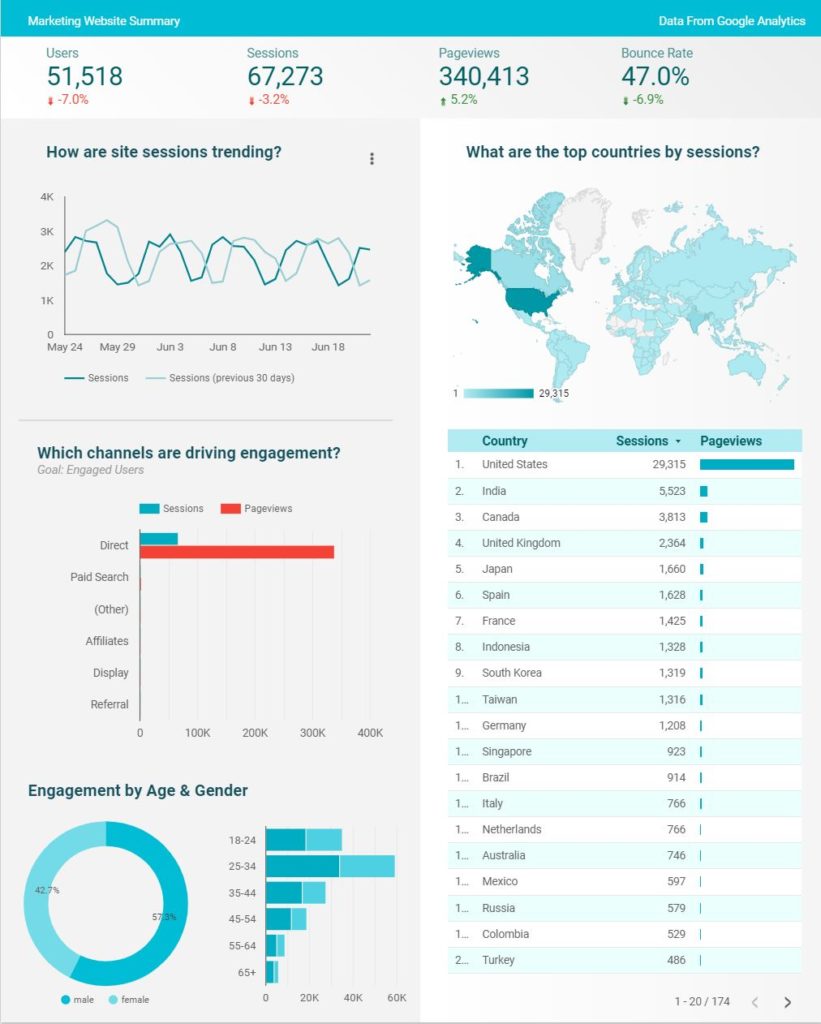
Lastly, it’s important to establish a reporting method and cadence. If you work for a larger organization, you might have access to a dashboard tool through a platform like Klipfolio, Tableau, or Duomo. If not, Google Data Studio is a nice, free platform that allows you to easily visualize data from both Google Analytics as well as from Google Sheets. You can use it to create a simple scorecard to track data weekly, monthly or as often as you’d like.
Moving Forward
Get certified with a Content Strategy + Analysis Certification, which is part of our Content Science Academy. This certification course not only digs deep on content analytics, but also provides an introduction to content strategy, content auditing, and user journeys that work for content and competitive content analysis.
Get Guidance from The Content Advantage, which includes a primer on conducting content analysis and a blueprint for developing content intelligence. You can use the information in the book to help you better understand elements and principles of effective and influential content.
Partner with Content Science: We are here to help you. If your organization is ready to get to work building a powerful content operation, you can engage Content Science to work with you and your team to develop a strategy that will put you on the path to success.
This article is part of our ongoing How To series, in which we help you learn how to get started in or improve across key content areas. Catch up with more in this series:
-
How To Start a Content Analysis
-
Why and How To Create a Content Calendar
-
How To Build a Content Operation
-
How To Start Crafting a Content Strategy
-
How To Optimize Your Content Strategy
The Authors

Content Science transforms content into business advantage in the age of AI. The award-winning firm partners with the world’s top companies and nonprofits to turn content into a strategic asset that powers digital experiences, customer engagement, and AI innovation. Guided by a mission to help worthy organizations make content make a difference, Content Science combines independent research; expert consulting, creative and technical services; and proprietary technologies—including the patented ContentWRX assessment platform and the ContentIQ AI content superagent—to define bold strategies, build better systems, and achieve breakthrough value.

Colleen Jones is the president of Content Science and a recognized expert on content, AI, and digital transformation, advising top organizations around the world such as Dell, Thompson Reuters, and The Home Depot. The author of the top-rated book The Content Advantage (third edition), Colleen hosts conversations with senior leaders on the Content Powers AI podcast.
A passionate entrepreneur, Colleen has led Content Science to conduct the world’s largest ongoing study of content operations and AI, develop the patented ContentWRX evaluation system, and architect the AI superagent ContentIQ.
She served as head of content at Mailchimp during its transformation into a marketing platform and eventual $12 billion acquisition by Intuit. Colleen also led customer experience transformation at AT&T and the CDC. Sharing insights based on her experience and her firm’s research, she is a frequent contributor to business and technology publications and podcasts as well as a top LinkedIn Learning instructor. Follow Colleen on LinkedIn.
Events, Resources, + More

Introducing ContentIQ: AI Superagent
Register for our webinar to learn more about Content Science's new AI superagent + see it in action.

Content Ops + AI Success
Get the latest report from the world's largest study of content operations. Benchmarks, success factors, commentary, + more!
The Ultimate Guide to End-to-End Content
Discover why + how an end-to-end approach is critical in the age of AI with this comprehensive white paper.
The Content Advantage Book
The much-anticipated third edition of the highly rated book by Colleen Jones is available at book retailers worldwide. Learn more.
Comments
We invite you to share your perspective in a constructive way. To comment, please sign in or register. Our moderating team will review all comments and may edit them for clarity. Our team also may delete comments that are off-topic or disrespectful. All postings become the property of
Content Science Review.