

The need for content in most businesses and organizations is growing. So is the interest in AI (artificial intelligence). And that means our idea of what content strategy is should grow, too. At Content Science, we view content strategy this way:
Content strategy is the integrated planning and management of content across channels, business functions, and end-to-end experiences. It is guided by a shared vision, aligned with business priorities, and implemented to enable consistent, trustworthy, and effective content at scale. Continuously informed by data, content strategy evolves as organizational goals, customer or audience needs, and other external conditions change.
This article explains more about what content strategy is in the age of AI and why that matters for your organization.
Resetting Our Idea of Content Strategy
Many organizations still approach content strategy as a planning exercise that produces guidelines, roadmaps, or messaging frameworks. Those outputs may be useful, but they are no longer sufficient.
Content now flows across marketing, product, support, sales, HR, communications, and more. It lives in platforms, products, and automated systems including AI. It consists of text, images, video, documents, and much more. It must be accurate, accessible, compliant, on brand, and responsive to change.
As Colleen Jones emphasizes in The Content Advantage, content is not a one-time deliverable. It is an ongoing responsibility that requires sustained investment and coordination, as she notes:
Content is an asset that requires ongoing care, not a one-time effort.
That framing alone shifts how leaders should think about content strategy. It’s less of a project and more of a system. So, let’s further explore four implications of resetting our views of content strategy.
1. From Single Strategy to Strategic Alignment
One of the most important shifts in modern content strategy is moving away from the idea that one unified strategy can govern all content efforts.
In practice, organizations operate with complex content needs and contexts. Product documentation does not behave like marketing content. Support content does not serve the same purpose as internal communications. Trying to force all of this into a single strategy often results in abstraction or disengagement.
As Colleen Jones notes in the article Modern Content Strategy:
A modern content strategy isn’t one monolithic plan. It’s a set of integrated strategies aligned by a shared vision.
A more effective approach is strategic alignment. Different content strategies may exist across teams or journeys, but they are connected by a shared vision, common principles, and integrated governance. This allows flexibility without fragmentation.
The goal of content strategy today is not uniformity. It’s coherence.
2. Content Strategy As a System, Not a Plan
Content strategy today functions less like a static plan and more like a system. It connects vision, decision-making, operations, and measurement into a living framework that guides how content is created, managed, and improved over time.
This system-level view brings together:
- Clear intent about the role of content.
- Operational models that make content sustainable.
- Standards that enable consistency and reuse.
- Measurement that informs change.
Without this system, content strategies tend to remain aspirational. With it, they become actionable and resilient.
Related: A Content Systems Framework
3. Content Operations Are Crucial
Content strategy and content operations are inseparable. Strategy sets direction, but operations determine whether that direction can be executed repeatedly and at scale.
Our research reported in What Makes Content Operations Successful in the Age of AI? shows that this connection has become crucial. While the vast majority of organizations are already using AI in some form, fewer than one-third report making moderate or fast progress scaling it across the enterprise. The strongest predictor of success is not the choice of AI tools, but the maturity of content operations.
Organizations with defined governance, clear ownership, integrated workflows, and content intelligence are significantly more likely to scale AI effectively and see measurable value from it.
As the report makes clear:
AI depends on content operations. Without mature content operations, AI amplifies inconsistency, risk, and inefficiency rather than value.
This is where many content strategies fall short. They articulate what content should be, but not how it will be sustained, governed, measured, and improved over time. In an AI-enabled environment, those gaps are exposed quickly.
Modern content strategy must account for issues such as staffing models, skills, lifecycles, workflows, governance, and measurement from the start. Content operations are not an execution detail. They are the infrastructure that makes strategy real and AI viable.
4. AI Is a Pressure Test
AI is not redefining content strategy. It is stress-testing it.
Generative AI, automation, and content intelligence tools expose weaknesses in content systems. If content is poorly governed, inconsistent, or disconnected from operations, AI magnifies those problems. If content is structured, well managed, and strategically aligned, AI amplifies value.
Our research shows that organizations with higher content maturity are far more successful at scaling AI. They move faster, manage risk more effectively, and see clearer returns. For example, Senior Director Cory Bennett of Sallie Mae has observed:
If your content operations aren’t solid, AI just amplifies the chaos. But if you have good governance and measurement in place, AI can accelerate quality and consistency instead of undermining them.
The differentiator is not AI ambition. It is content readiness.
In this context, an effective content strategy provides the right guardrails to make AI useful rather than reckless.
Why This Matters for Leaders
For leaders, it’s an exciting time. Content strategy is a crucial capability that makes or breaks business success in the age of AI.
Organizations that treat content as a strategic asset are better equipped to:
- Deliver coherent experiences across touchpoints.
- Reduce duplication and inefficiency.
- Adapt to change without losing direction.
- Scale content and AI responsibly.
With a modern view of content strategy, your organization can shift from reactive content decisions to intentional, repeatable outcomes.
The Author

Content Science transforms content into business advantage in the age of AI. The award-winning firm partners with the world’s top companies and nonprofits to turn content into a strategic asset that powers digital experiences, customer engagement, and AI innovation. Guided by a mission to help worthy organizations make content make a difference, Content Science combines independent research; expert consulting, creative and technical services; and proprietary technologies—including the patented ContentWRX assessment platform and the ContentIQ AI content superagent—to define bold strategies, build better systems, and achieve breakthrough value.
What to Check Out Next
Events, Resources, + More

Introducing ContentIQ: AI Superagent
Register for our webinar to learn more about Content Science's new AI superagent + see it in action.
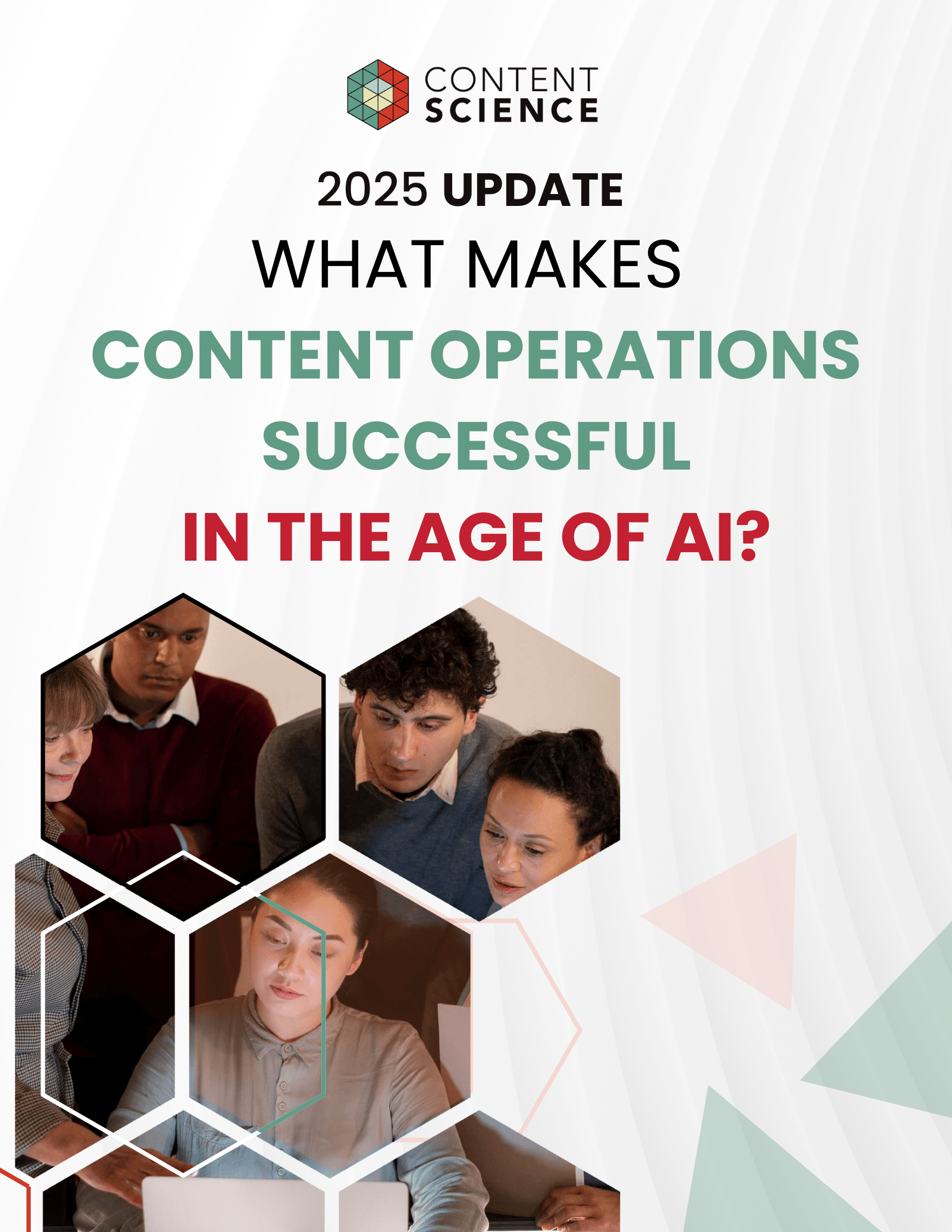
Content Ops + AI Success
Get the latest report from the world's largest study of content operations. Benchmarks, success factors, commentary, + more!
The Ultimate Guide to End-to-End Content
Discover why + how an end-to-end approach is critical in the age of AI with this comprehensive white paper.
The Content Advantage Book
The much-anticipated third edition of the highly rated book by Colleen Jones is available at book retailers worldwide. Learn more.
Comments
We invite you to share your perspective in a constructive way. To comment, please sign in or register. Our moderating team will review all comments and may edit them for clarity. Our team also may delete comments that are off-topic or disrespectful. All postings become the property of
Content Science Review.