

A gap is widening between AI adoption and AI transformation that achieves value. Gartner predicts worldwide artificial intelligence spending will reach $2.5 trillion this year. Employees are incorporating it into their daily work. Yet most enterprises continue to struggle to create measurable business value at scale.
I call this disparity the AI strategy gap. More specifically, I define it this way:
The AI strategy gap is the disconnect between implementing AI technologies and transforming the organization needed to realize their value.
As evidence that this gap exists, consider these points:
- MIT reported last year that that 95% of corporate AI initiatives failed to scale beyond pilot.
- Content Science research recently found that while 86% of organizations report using AI, only 29% report moderate or fast progress with AI adoption.
- Gartner finds AI-related layoffs aren’t bringing expected returns and predicts that by 2027, 50% of enterprises without a people‑centric AI strategy will lose their top AI talent.
- PwC recently found that 56% of CEOs are not seeing cost savings or revenue gains from AI.
So, why does this gap exist? I find MIT researcher Nick von der Meulen summarizes the issue well:
Organizations are applying yesterday’s best practices to an inherently different technology. They govern AI like legacy IT…and treat AI as another skill to acquire when it’s actually redefining what skilled work looks like.
At the same time, individuals are adopting AI for their work faster than organizations are transforming. Recently in Harvard Business Review, analysis of more than 12,600 real-world AI use cases found that people are using AI in their jobs for broader and more sophisticated tasks such as analysis, decision-making, coaching, coding, and more.
The kicker is their employers don’t necessarily know all this AI use is happening.
This phenomenon is called shadow AI. And while the governance and security risks here are very concerning and worth their own articles, here I want to point out shadow AI as a symptom of the AI strategy gap. Individuals see opportunities to create value with AI that their employers haven’t recognized or enabled.
Related: Closing the AI Strategy Gap with Content Science (PDF)
Closing this gap requires getting more strategic about AI.
What Is AI Strategy?
After a lot of consideration and research, I have come to view organizational AI strategy this way:
AI strategy is the blueprint for transforming how an organization creates value in the age of AI.
It aligns vision, content, workflows, people, governance, technology, and operating models to achieve business outcomes at scale. AI strategy isn’t primarily about implementing technology. it’s about redesigning how people and AI create value together.
Many organizations are defining AI strategy as a technology roadmap—a plan for selecting AI tools, identifying use cases, managing risk, and training employees. While those activities matter, they are not the strategy itself.
Organizations can purchase best-in-class AI platforms, establish governance policies, and teach prompt engineering while still failing to create measurable business value. That’s because AI can’t succeed on its own. It depends on content, workflows, governance, systems, leadership, and people working together.
That’s why I believe AI strategy is fundamentally a transformation strategy. After working with a range of organizations on transformation and modernization efforts over the past decade, I’ve identified several key elements for AI strategy.
Six Elements of an Effective Organizational AI Strategy
Every organization’s strategy will be unique, but the most successful ones address six interconnected elements.
1. Vision and Business Outcomes
Technology isn’t the starting point. Instead, begin by asking questions like: What business outcomes are we trying to achieve? What does our future business look like to our customers, employees, and stakeholders?
Whether the goal is improving customer experience, increasing productivity, reducing costs, accelerating innovation, or creating new business models, AI initiatives need a clear vision that defines the future state. Then AI strategy defines how to move from the current state to the future state, guiding investment and key decisions along the way.
2. Content and Knowledge Foundations
One of the biggest differences between AI transformation and previous digital transformations is the role of content. Content is no longer simply something organizations publish. It has become the knowledge layer that powers AI.
AI systems learn from content. Retrieve content. Generate content. Personalize content. Increasingly, customers experience AI through content. That means organizations must invest in systems for content quality, structure, governance, metadata, and knowledge management.
Content Science’s latest research found that most organizations continue to operate at relatively low levels of content operations maturity, limiting their ability to scale AI effectively. But the organizations reporting the most success with AI also had the most mature content operations. The connection is clear.
3. Workflows and Operating Models
AI doesn’t create lasting value by automating isolated tasks. It creates value by redesigning how work flows across people, content, systems, and decisions. That’s why organizations should stop asking, “Which tasks can AI automate?” and start asking, “How should AI transform this workflow?”
The greatest opportunities often lie not in making individual employees faster, but in reimagining end-to-end workflows—how work is initiated, how knowledge flows, where decisions are made, how content is created and governed, when humans intervene, and how outcomes are measured.
This is also where organizations can move beyond shadow AI. Rather than relying on employees to build ad hoc AI-assisted workflows, leaders can intentionally redesign workflows that combine human expertise, organizational knowledge, governance, and the appropriate AI capabilities. The result is not simply greater efficiency, but more consistent, trusted, and scalable ways of creating value.
This is the premise behind our end-to-end (E2E) approach at Content Science. Instead of optimizing isolated touchpoints, organizations improve the entire content ecosystem—from customer experiences and content lifecycles to governance, intelligence, and supporting systems. AI succeeds when it enhances the whole workflow, not just one task within it.
4. Workforce, Skills, and Change Management
AI strategy isn’t simply about preparing technology. It’s also about preparing people. Every major transformation changes roles, responsibilities, workflows, and expectations. AI is no different. In many organizations, the greatest barriers to AI adoption aren’t technical. They’re organizational.
Employees need more than training on AI tools. They need to understand why work is changing, how their roles will evolve, where human judgment remains essential, and how AI can augment their expertise. Leaders need to communicate a clear vision, create opportunities for experimentation, and equip teams with the skills and confidence to adopt new ways of working.
Content Science research finds that organizations with higher levels of operational maturity are significantly more likely to provide training related to content and AI and, in turn, report faster progress in adopting AI and more success overall. Training is crucial.
And successful change management extends beyond training. It requires ongoing communication, leadership alignment, cross-functional collaboration, enablement content, and a culture that embraces continuous learning and adaptation. Ultimately, AI strategy involves about helping people succeed in a transformed operating model. Organizations that invest in change management are far more likely to realize sustained business value than those that simply deploy new technology.
5. Governance, Customer Experience, and Trust
Trust is one of an organization’s most valuable assets. AI strategy should strengthen trust with employees, partners, and customers, not undermine it.
Governance is often framed in terms of risk management: ensuring compliance, protecting privacy, reducing bias, managing intellectual property, and establishing accountability. Those responsibilities remain essential. But governance should also be viewed through the lens of customer experience.
Every AI-enabled interaction influences how employees and customers perceive an organization. Whether customers receive an AI-generated answer, personalized recommendation, product description, or support experience, they expect it to be accurate, helpful, transparent, and consistent with the organization’s brand and values.
That makes governance inseparable from employee enablement and customer experience. Organizations need guardrails that ensure AI-generated content is trustworthy, high quality, and appropriate while preserving the human-centered experiences everyone expects.
An end-to-end perspective here is especially important. Rather than governing individual AI applications in isolation, organizations should consider the entire customer journey and the content, business functions, workflows, and systems that shape it. Done well, governance doesn’t slow progress or innovation. Instead, it builds the trust that allows organizations to innovate with confidence.
6. Technology and AI Choices
The technology component of AI strategy should be a series of deliberate choices, not simply a purchasing decision.
As an example, one choice is the type of AI. Select the right type of AI for the right problems or needs. When many executives talk about AI, they are referring to generative AI. In reality, organizations may employ machine learning, predictive AI, recommendation systems, retrieval-augmented generation (RAG), generative AI, agentic AI, or combinations of these capabilities. Each serves different purposes and should be matched to specific business goals, workflows, and customer needs.
In a similar vein, even within one type of AI, different tools, products, and models have strengths and weaknesses to consider. Not all generative AI tools, for example, are equally good at creating all types of content or code.
But AI type is only one strategic choice. A few other examples:
- Whether premium or mid tier LLMs provide the best result for the best value. In light of the tokenpocalypse, it’s important to not use a Lamborghini model when a Toyota will do.
- Whether to build the AI solution(s) or buy them. You can build proprietary AI models and systems or buy existing tools and platforms that integrate AI.
- Whether to lock in with one AI partner or stay diversified. I’m surprised at how many lock-in agreements I hear announced proudly by large companies when, as I noted earlier, different AI types and products are good at different things. And that relates to the next choice…
- Whether to work directly with a large AI partner or use a marketplace / indirect option. This choice affects whether and how your data and intellectual property are available to companies like OpenAI and Anthropic. They both have a history of taking what they learn and creating a competitive offering. The latest example is Anthropic secretly working on Claude Design while working closely with Figma.
Organizations should make these choices proactively, in light of their own strategy. I’m concerned many organizations are making them reactively, under pressure from the hype, fear, or both.
Are Content Strategy and AI Strategy Converging?
One significant implication of the AI era is the changing role of content. For years, organizations viewed content as the output of work. Today, content is increasingly the input, the output, and the interface.
That’s why I believe enterprise content strategy and enterprise AI strategy are becoming inseparable. Content is the knowledge layer that fuels AI, the interface through which customers experience AI, and one of AI’s most valuable outputs. Organizations that separate the two will struggle to realize AI’s full value. Organizations that strengthen content strategy and operations are building the foundation for AI that scales. Too many organizations are missing this, thinking their content approach is unnecessary, not a crucial foundation to AI success.
I like the way Steven Pritt, Vice President of Content Marketing at Thomson Reuters, describes the relationship in our research report What Makes Content Operations Successful in the Age of AI?
As AI continues to evolve, effective content operations are becoming increasingly important. They not only streamline the content creation process but also allow us to maintain control over our narrative, ensuring that our messaging is coherent and resonates with our target audience across all channels. Content operations should be the backbone of modern content teams, as they integrate our platforms, technology stack, and AI to work seamlessly together.
And in our data, we find higher levels of content strategy and operations maturity correlate strongly with higher levels of AI adoption and general success.
Toward Closing the AI Strategy Gap
The organizations that succeed with AI won’t necessarily be those with the newest premium models or the biggest technology budgets. They’ll be the organizations that transform how they create value.
Closing the AI strategy gap doesn’t begin with buying “better” AI and trying to implement it quickly. It begins with building a better strategy that aligns vision, content, workflows, people, governance, operating models, and technology into a coherent system for transformation.
The Author

Colleen Jones is the president of Content Science and a recognized expert on content, AI, and digital transformation, advising top organizations around the world such as Dell, Thompson Reuters, and The Home Depot. The author of the top-rated book The Content Advantage (third edition), Colleen hosts conversations with senior leaders on the Content Powers AI podcast.
A passionate entrepreneur, Colleen has led Content Science to conduct the world’s largest ongoing study of content operations and AI, develop the patented ContentWRX evaluation system, and architect the AI superagent ContentIQ.
She served as head of content at Mailchimp during its transformation into a marketing platform and eventual $12 billion acquisition by Intuit. Colleen also led customer experience transformation at AT&T and the CDC. Sharing insights based on her experience and her firm’s research, she is a frequent contributor to business and technology publications and podcasts as well as a top LinkedIn Learning instructor. Follow Colleen on LinkedIn.
Events, Resources, + More

Introducing ContentIQ: AI Superagent
Register for our webinar to learn more about Content Science's new AI superagent + see it in action.
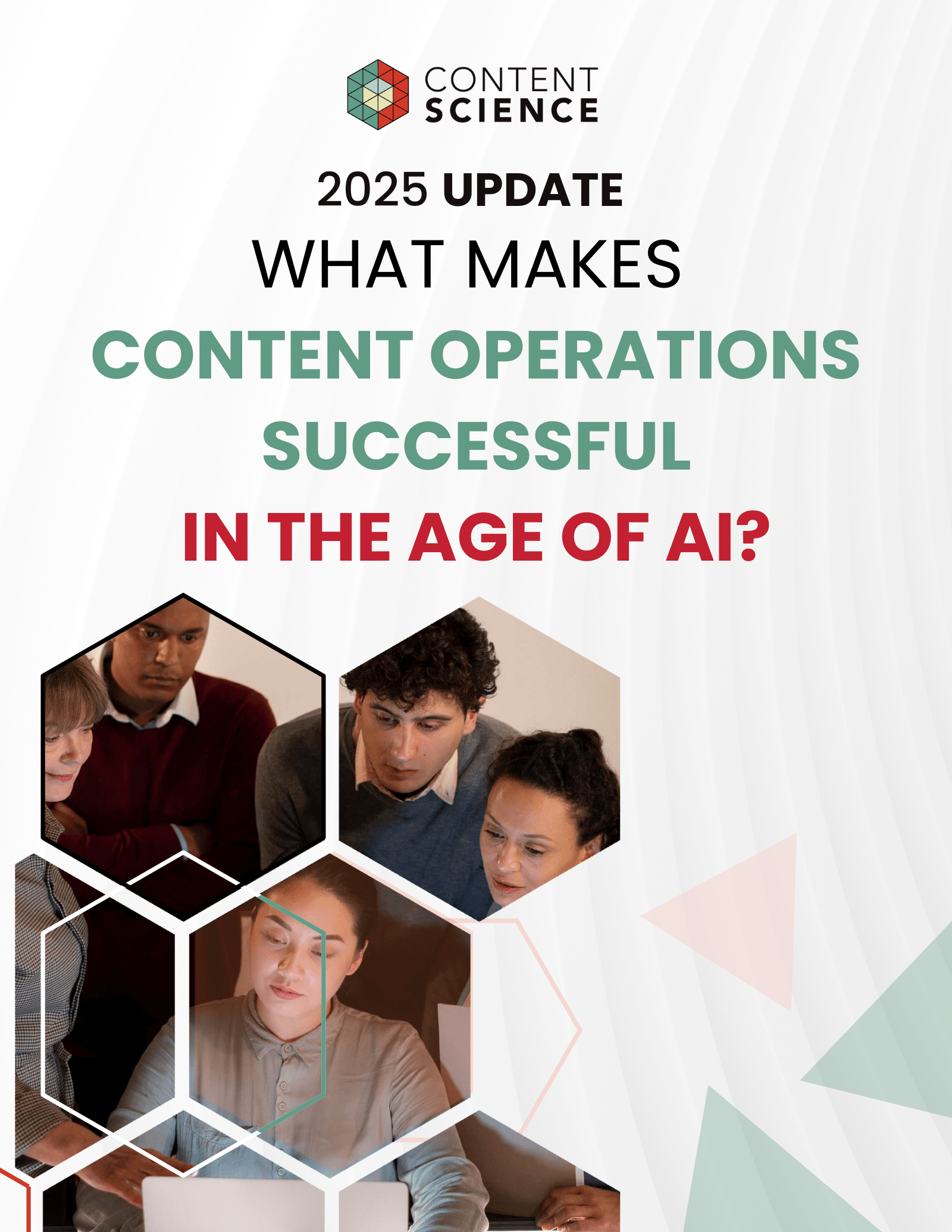
Content Ops + AI Success
Get the latest report from the world's largest study of content operations. Benchmarks, success factors, commentary, + more!
The Ultimate Guide to End-to-End Content
Discover why + how an end-to-end approach is critical in the age of AI with this comprehensive white paper.
The Content Advantage Book
The much-anticipated third edition of the highly rated book by Colleen Jones is available at book retailers worldwide. Learn more.
Comments
We invite you to share your perspective in a constructive way. To comment, please sign in or register. Our moderating team will review all comments and may edit them for clarity. Our team also may delete comments that are off-topic or disrespectful. All postings become the property of
Content Science Review.